



Table of Contents
- ⚡️ Key Takeaways — 3-Minute Summary
- 1. The Two Types of Vacation Rental Costs
- 2. 7 Ways to Cut Vacation Rental Costs in Japan
- 3. Common Concerns — and What to Do About Them
- 4. With AirHost, You Can Run Your Vacation Rental Efficiently — On Your Own Terms
- Ready to Talk Numbers? Get in Touch.
- FAQ
- Conclusion | Know Your Costs. Run a Smarter Operation.
- Related Articles
Japan Vacation Rental Costs Explained: Startup Investment & Monthly Expenses
![Japan Vacation Rental Costs Explained: Startup Investment & Monthly Expenses [2026 Guide]](http://images.ctfassets.net/q5m53pi41ft0/1wtoVYCu66iqkZ17M5DInF/69c7d9310528fad2beefeebcc8556027/_______eyecatch.jpeg "Japan Vacation Rental Costs Explained: Startup Investment & Monthly Expenses [2026 Guide]")
"I want to start a vacation rental in Japan — but I have no idea how much it's going to cost me."
"Will monthly expenses eat up my profit before I even get started?"
"How do I keep costs under control while still giving guests a great experience?"
Hi there! This article is brought to you by the AirHost Digital Marketing Team.
If any of those questions sound familiar, you're in the right place. In this guide, we break down every major cost involved in running a vacation rental in Japan — both the one-time startup investment and the ongoing monthly expenses. We'll also share seven practical ways to cut costs without sacrificing the guest experience that keeps your ratings high.
⚡️ Key Takeaways — 3-Minute Summary
Startup costs for a vacation rental in Japan typically run ¥500,000–¥3,000,000, depending on property size and location
Monthly running costs average ¥120,000–¥500,000 — cleaning is often the most variable expense
There are 7 proven ways to reduce costs without compromising guest quality
IT subsidy programs in Japan may help offset the cost of property management software
For owners who want to manage their own property, automating reservations, cleaning schedules, and guest messaging delivers the best return on investment
What are vacation rental costs in Japan?
Costs fall into two buckets: startup costs (a one-time investment before you open your doors) and running costs (monthly expenses that continue as long as you operate). Understanding both is essential for building a realistic business plan — and for staying profitable once guests start arriving.
1. The Two Types of Vacation Rental Costs
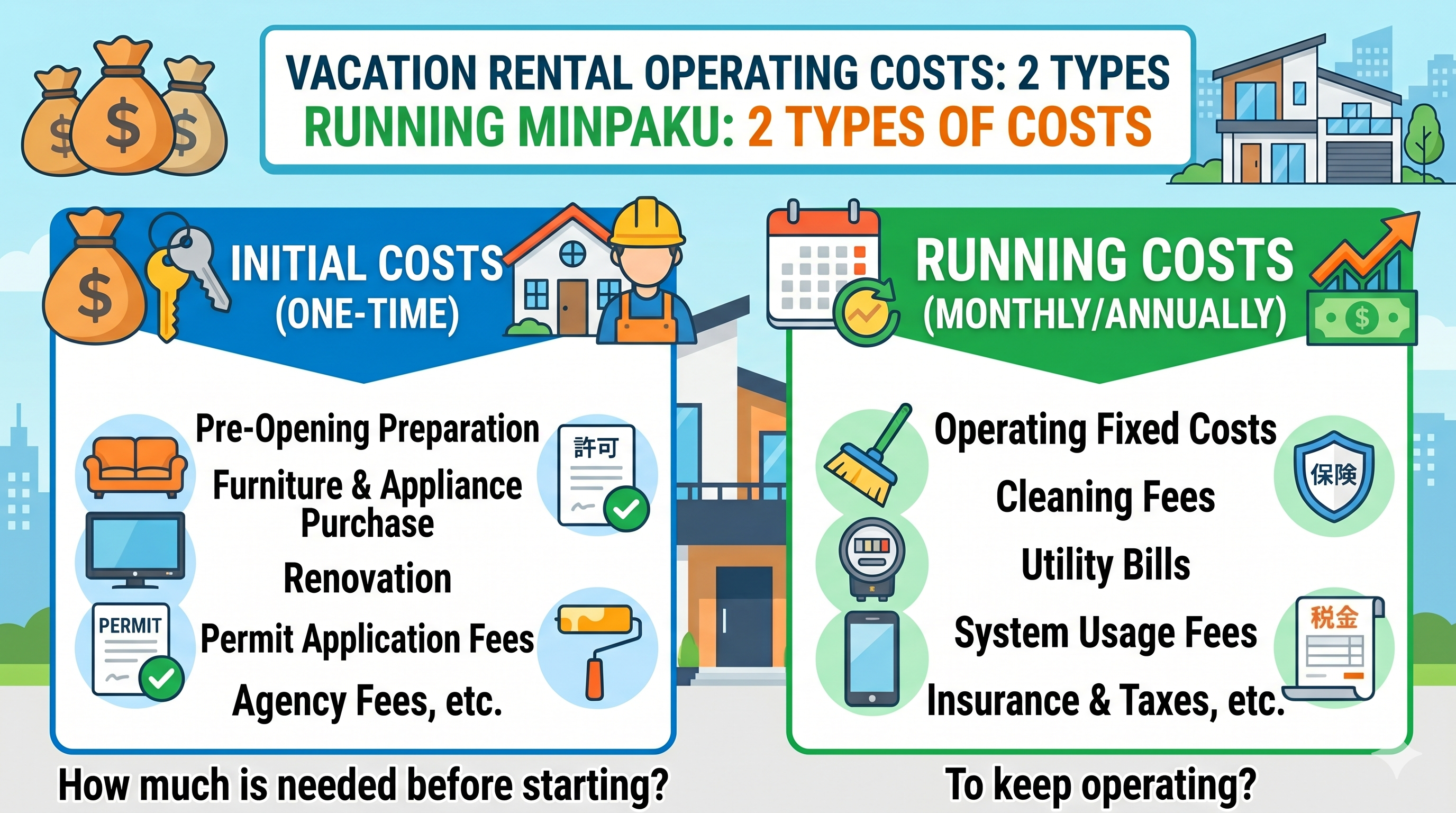
Startup Costs: How Much Do You Need Before You Open?
Startup costs are the one-time expenses required to get your vacation rental up and running.
Main Startup Cost Items (Japan estimates):
Item | What's Included | Estimated Cost |
Property Acquisition (rented) | Security deposit, key money, agent fee, advance rent | ¥200,000 – ¥1,000,000 |
Furniture & Appliances | Bed, refrigerator, TV, washing machine, microwave, cookware, dishes | ¥200,000 – ¥1,000,000 |
Linens | Sheets, towels, pillowcases | ¥30,000 – ¥100,000 |
Fire Safety Equipment | Fire extinguisher, smoke detector | ¥50,000 – ¥200,000 |
Wi-Fi Installation | Internet line setup, router purchase | ¥20,000 – ¥50,000 |
Supplies & Consumables | Shampoo, conditioner, body wash, toilet paper, detergent | ¥20,000 – ¥50,000 |
Marketing & Listing | OTA listing setup, professional photography | ¥10,000 – ¥100,000 |
Permit Application | Required notifications under the Minpaku Law or relevant licensing | ¥10,000 – ¥30,000 |
Total estimated startup cost: ¥500,000 – ¥3,000,000. The range is wide because property size, location, furnishing quality, and target guest profile all play a significant role.
📌 Tip: Subsidies May Help Cover Software Costs
If you plan to use a property management system (PMS) or channel manager to run your vacation rental, the cost of those tools may qualify for Japan's IT Adoption Subsidy (IT導入補助金) or similar public funding programs.
Eligibility depends on your business structure and the specific software — requirements change each fiscal year. Check the latest details at your local Chamber of Commerce or the Ministry of Economy, Trade and Industry (METI) website. We recommend confirming eligibility directly with the subsidy office before making purchasing decisions.
Monthly Running Costs: What Does It Cost to Keep the Doors Open?
Running costs are the recurring monthly expenses you'll pay as long as you're operating.
Main Monthly Running Cost Items (Japan estimates):
Item | What's Included | Est. Monthly Cost |
Rent or Mortgage | Monthly rent for leased property, or mortgage repayment | ¥50,000 – ¥300,000 |
Utilities | Electricity, gas, water | ¥20,000 – ¥50,000 |
Internet & Communication | Internet service, Wi-Fi router rental | ¥3,000 – ¥5,000 |
Consumables | Restocking shampoo, soap, toilet paper, detergent | ¥10,000 – ¥30,000 |
Linen Cleaning | Sheets, towels, pillowcases — laundry or linen service | ¥10,000 – ¥30,000 |
Cleaning Fees | Post-checkout cleaning, periodic deep cleans | ¥15,000 – ¥50,000 |
Marketing & Listing | Ongoing OTA listing fees, promotional spend | ¥10,000 – ¥50,000 |
Management Fees | If using a full-service management company | 10%–30% of revenue |
Maintenance & Repairs | Equipment failures, guest damage | ¥a few thousand – ¥hundreds of thousands |
Total estimated monthly running costs: ¥120,000 – ¥500,000, including cleaning.
These figures shift considerably based on guest volume, property size, your management approach, and how often the property is cleaned. Cleaning costs in particular deserve close attention — they scale directly with occupancy and have a big impact on guest satisfaction scores.
Pro Tip! |
Cleaning is non-negotiable. It's the single biggest driver of guest ratings — and bad ratings compound quickly on OTA platforms. Think of cleaning less as a cost to minimize and more as an investment in repeat bookings and reviews. If you're cleaning yourself, factor in your time cost too. |
2. 7 Ways to Cut Vacation Rental Costs in Japan
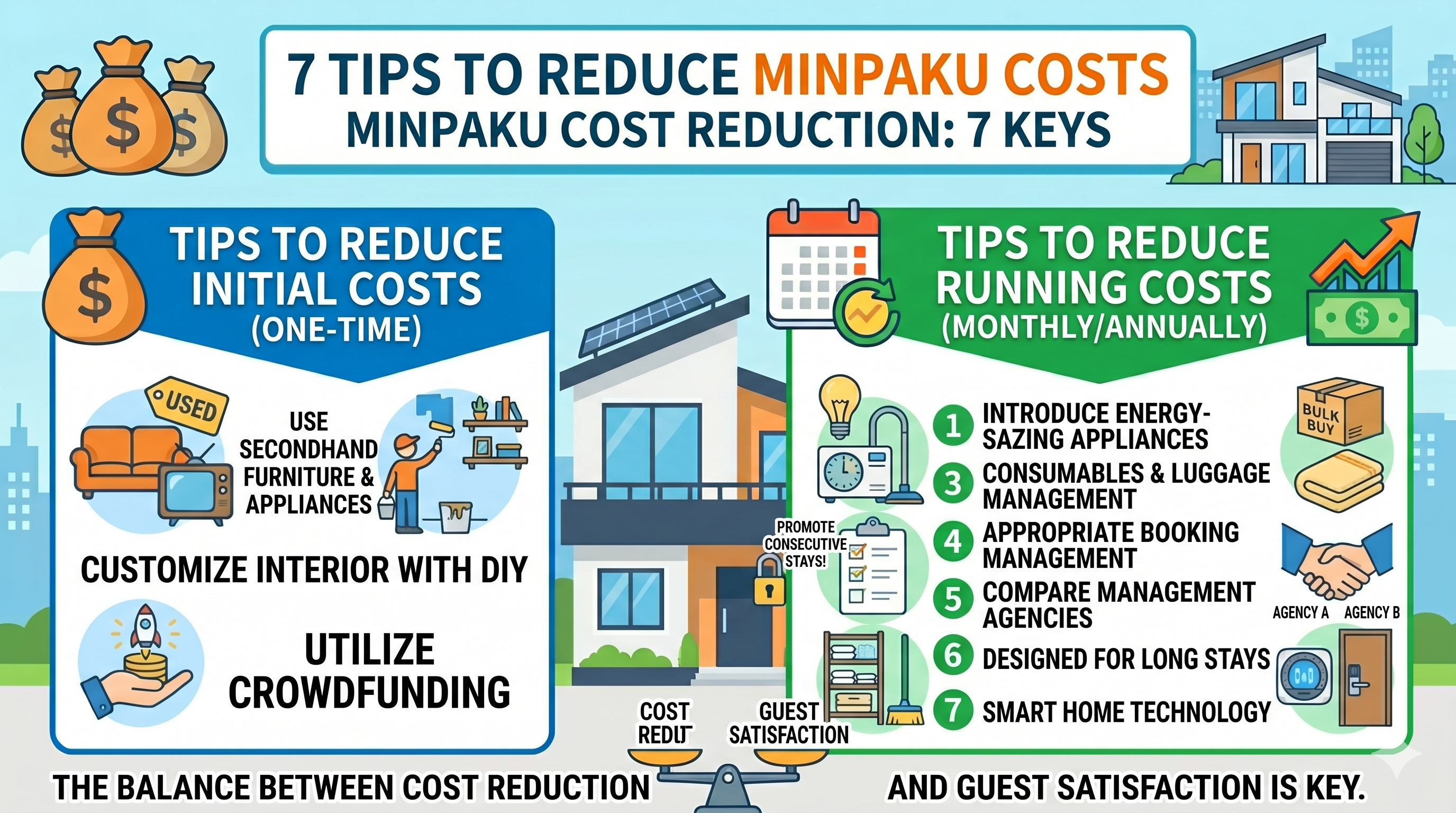
The goal isn't to spend as little as possible — it's to spend smartly. Here's how to reduce costs without losing guest quality.
Reducing Startup Costs
Buy quality second-hand furniture: Japan has a strong market for used furniture in excellent condition. You can furnish a unit attractively at a fraction of the cost of buying new.
DIY interior touches: Wallpaper, shelving, or decorative accents done yourself can add character to a space while keeping fit-out costs down.
Explore crowdfunding: Some hosts in Japan have used crowdfunding to raise initial capital, particularly when the property has a strong local story or concept.
Reducing Monthly Running Costs
Invest in energy-efficient appliances
LED lighting, inverter air conditioners, and energy-efficient water heaters can meaningfully reduce monthly utility bills.
Build a streamlined cleaning system
Standardize post-checkout cleaning so it's fast and consistent.
A long-term contract with a local cleaning company often brings the per-clean rate down.
Manage consumables in bulk
Buy shampoo, soap, and paper goods in bulk to reduce unit costs.
Choose durable, refillable dispensers rather than single-use amenity bottles.
Encourage longer stays
Longer stays mean fewer checkout-cleanings per month — one of the most direct ways to reduce cleaning spend.
A small discount for 7-night or 14-night stays often more than pays for itself.
Audit your management costs
Compare what you outsource against what you could automate with software.
Full-service management companies typically charge 10–30% of revenue; property management software typically costs a flat monthly fee — often far less.
Set up long-stay guest options
Provide extra linens and a basic cleaning kit so guests on extended stays can handle light cleaning themselves.
This reduces your linen exchange costs and builds goodwill with long-term guests.
Use smart home technology
Smart locks eliminate physical key handoffs (and the scheduling headaches that come with them).
Smart thermostats cut energy waste between guest stays.
Combine several of these approaches and you can meaningfully lower your monthly burn without guests ever noticing the difference.
3. Common Concerns — and What to Do About Them
Common Concern | Practical Solution |
"Startup costs are higher than I expected" | Second-hand furniture, DIY finishing, and possible IT subsidy support can reduce initial outlay significantly |
"Cleaning costs are eating my margin" | Longer stays + cleaning company long-term contracts lower per-clean costs. Automation tools can optimize scheduling |
"I'm worried about vacancy between bookings" | Listing on multiple OTAs simultaneously with dynamic pricing lifts occupancy. A channel manager syncs inventory automatically |
"Managing everything myself feels overwhelming" | A property management system handles reservations, cleaning schedules, and guest messaging — one person can manage multiple units |
"I'm not confident handling guests who don't speak Japanese" | Multilingual auto-messaging (English, Chinese, Korean) built into a PMS covers most inbound guest communication automatically |
4. With AirHost, You Can Run Your Vacation Rental Efficiently — On Your Own Terms
"I want to keep costs down and stay in control of my property — but I don't want to be answering guest messages at 2am."
That's exactly the problem AirHost was built to solve.
AirHost is a cloud-based property management system (PMS) and channel manager built specifically for vacation rentals, guesthouses, ryokan, and hotels in Japan. It connects your listings across multiple OTAs — Airbnb, Booking.com, Rakuten Travel, Jalan, and more — and handles reservation syncing, pricing, cleaning coordination, and multilingual guest communication automatically.
You stay the owner. AirHost handles the operations.
Key benefits for Japan-based operators:
One dashboard for all your OTAs
Sync availability and pricing across all channels in real time. No more manual updates, no more double bookings.Automated multilingual guest messaging
Pre-set messages go out in English, Chinese, Korean, and Japanese — automatically triggered at check-in, check-out, and whenever a guest asks a standard question. Inbound guests get fast, accurate responses without you lifting a finger.
See AI assistant▶Bringing the "AI Assistant" to Every Accommodation.
Cleaning schedule automation
Cleaners get notified automatically after each checkout. You can track progress and flag issues from the same dashboard.Smart pricing to maximize revenue
Dynamic pricing adjusts your rates based on demand, seasonality, and competitor rates — so you're not leaving money on the table during busy periods or charging too much during slow ones.
▶ See how AirHost works: System Introduction
Need more support? Full management service is also available.
If you'd prefer to hand off more than just the software side, AirHost also offers a full property management service — covering OTA registration, pricing strategy, cleaning, and guest communication end to end. This is an optional add-on, not a requirement; most AirHost customers run their properties themselves using the platform.
▶ Explore AirHost's management service
Ready to Talk Numbers? Get in Touch.
Not sure which setup is right for your property? We're happy to walk you through the options — pricing, supported languages, and what getting started actually looks like. No hard sell, just a straight conversation.
FAQ
Q1. What languages does AirHost support for guest communication?
AirHost supports automated messaging in Japanese, English, Chinese (Simplified and Traditional), and Korean, with additional languages available depending on your plan. For inbound guests arriving from overseas, messages can be sent automatically in their language at key moments — booking confirmation, check-in instructions, checkout reminders — without any manual input from you.
Q2. How much does AirHost cost?
Pricing depends on the number of units you manage and which features you need. AirHost offers plans for individual hosts managing a single property as well as for operators managing larger portfolios. The best way to get an accurate quote is to contact us directly — we'll give you a clear breakdown with no surprises. For comparison, a full-service management company typically charges 10–30% of your revenue; AirHost's system fee is a flat monthly rate, which is usually significantly lower.
Q3. I already use a PMS. How difficult is it to switch to or add AirHost?
AirHost is designed to integrate with existing workflows, not replace them from scratch. Most operators are up and running within a few days. The setup process is handled with support from the AirHost team, and there's no need to re-list your properties manually — OTA connections are handled during onboarding. If you're already on another system, the team can advise on migration options.
Q4. What are the most important cost items to budget for when starting out in Japan?
Beyond the obvious (property, furniture, appliances), the items that surprise first-time hosts most often are: fire safety equipment (required by Japanese law), permit application costs under the Minpaku Law or relevant licensing, and professional photography for OTA listings (which directly affects how many bookings you get in the first month). Budget these in from the start.
Q5. Can I manage a vacation rental in Japan without a management company?
Yes — and most successful hosts in Japan do. What matters is having the right systems in place. A property management platform handles the operational complexity (OTA syncing, dynamic pricing, multilingual messaging, cleaning coordination) so you can manage one or several properties without relying on a third-party management company.
Q6. What are Japan's legal requirements for running a vacation rental?
Japan's vacation rental market is regulated under three main frameworks: the Minpaku Law (住宅宿泊事業法), Special Zone Minpaku (特区民泊), and the Ryokan Business Act (旅館業法). Each has different operating day limits, permit requirements, and costs. Choosing the right one for your property type and location affects your total costs significantly. See our related article for a full comparison.
Conclusion | Know Your Costs. Run a Smarter Operation.
Running a vacation rental in Japan involves real costs — but they're manageable when you plan for them and use the right tools. The hosts who thrive are the ones who understand their numbers, eliminate waste in the right places, and invest in systems that let them scale without burning out.
Let the system handle the admin. Focus on what makes your property worth staying in.
AirHost is built for exactly that. If you'd like to see what it could do for your property, we'd love to hear from you.
Related Articles
Related Articles ▼ |
What is AirHost? Features & Benefits Explained [With Diagrams] |
Japan Vacation Rental Regulations: Minpaku Law vs. Special Zone vs. Ryokan Act — Which Applies to You? (link when live) |
Let AirHost help your business grow.
Our experts are here to support your requests anytime.