



Table of Contents
Japan's Accommodation Tax in 2026: How AirHost PMS Automates Compliance

Last updated: July 9, 2026
AirHost PMS supports Japan's accommodation tax (宿泊税, shukuhaku-zei). It automatically calculates the tax based on each municipality's rules, adds it to reservations, supports cashless collection from guests, and generates reports for tax filing — all in one system.
"My city is introducing an accommodation tax next year — what am I actually supposed to do?"
"Most of my bookings come through OTAs. Who collects the tax, and how?"
"I run my properties remotely. There's no front desk to collect anything."
Hi there! This article is brought to you by the AirHost Digital Marketing Team. If any of those questions sound familiar, you're in the right place. Whether you run a hotel, a ryokan, or remotely managed vacation rentals, this article walks you through what's changing with Japan's accommodation tax in 2026 — and how AirHost takes most of the manual work off your plate.
⚡️ 3-Minute Read: Everything You Need to Know
Why AirHost is ready for accommodation tax compliance
How AirHost simplifies accommodation tax management
How AirHost keeps your property compliant

What is Japan's accommodation tax — and why 2026 matters
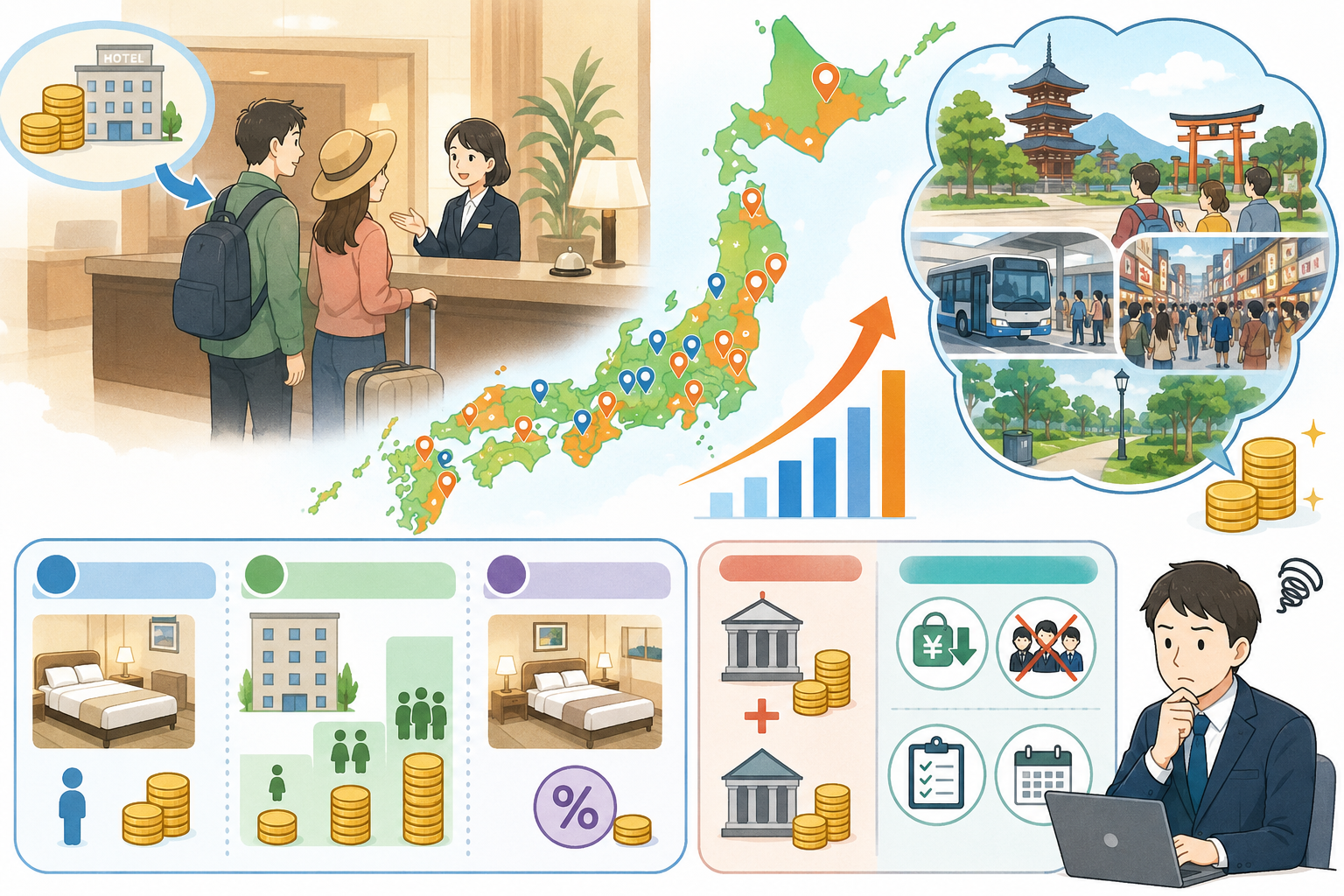
The accommodation tax is a local tax charged per guest, per night, at hotels, ryokan, and vacation rentals (minpaku). Revenue funds tourism infrastructure and overtourism countermeasures.
Tokyo introduced Japan's first accommodation tax in 2002, followed by Osaka, Kyoto, Fukuoka, and others. The pace has now accelerated dramatically: 17 municipalities had the tax at the end of 2025, around 30 more begin collecting in 2026, and the total is expected to reach roughly 50 by the end of the year. New adopters in 2026 include Hokkaido (prefecture-wide), Miyagi Prefecture and Sendai City, Yugawara, and Kumamoto City.
In other words: if you operate accommodation in a major Japanese destination, the question is no longer if the tax applies to you, but when.
Three tax structures — and why they complicate operations
Structure | How it works | Examples |
Flat rate | Fixed amount per guest per night | Fukuoka City |
Tiered | Amount depends on the nightly room rate | Tokyo, Kyoto City, Osaka |
Percentage | A % of the room rate | Kutchan (Niseko area) |
On top of that, some regions apply prefectural and municipal taxes simultaneously (e.g., Miyagi Prefecture + Sendai City, Hokkaido + Sapporo), and each municipality sets its own exemption threshold (e.g., stays under ¥5,000 per night) and exclusions such as school trips. The rules genuinely differ city by city.
Confusing? Absolutely. That's exactly why how much your PMS can handle for you matters so much.
What happens without a tax-ready PMS — and what changes with one
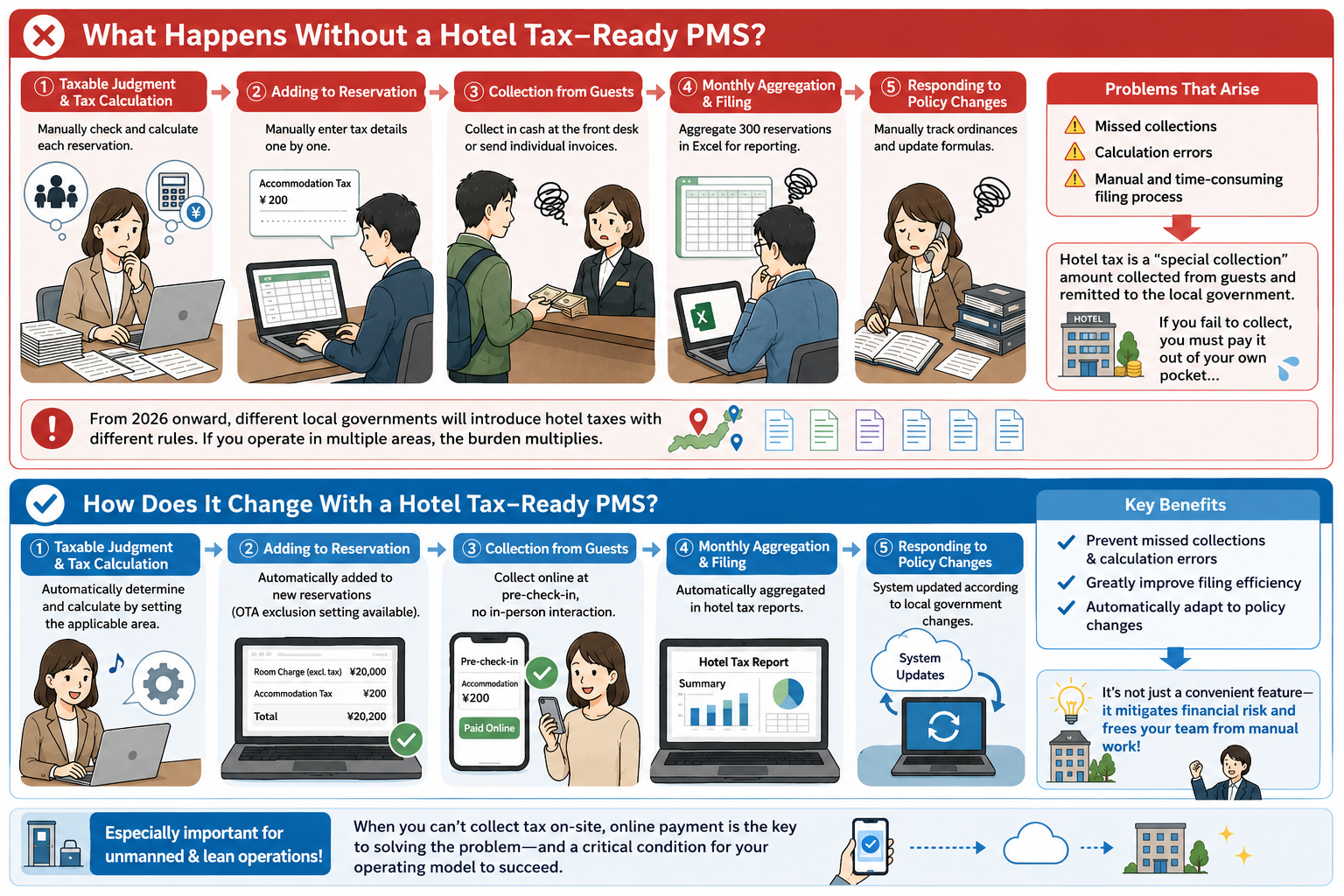
If "accommodation tax support" sounds abstract, here's what the tax actually means in day-to-day operations without PMS support.
Say you run a 10-room property in Tokyo with 300 room-nights per month. Without a tax-ready PMS, every single step is manual:
Assess each reservation — is the nightly rate (excluding consumption tax) above the taxable threshold? How many guests? Now repeat that 300 times.
Calculate the amount — Tokyo uses a tiered structure where the tax changes with the rate band, calculated on the rate net of consumption tax, so you first have to back the consumption tax out.
Collect it — most OTA bookings arrive without the tax collected, so you collect cash at the desk or bill guests individually.
Aggregate and file — tally 300 reservations in a spreadsheet and file in each municipality's format.
Exhausting just to read, right? The predictable results are missed collections, calculation errors, and filing work that depends on the one person who knows the process.
And here's the part that catches many operators off guard: the accommodation tax works as a withholding scheme. Your property collects it from guests and remits it to the municipality — and if you fail to collect it, you still owe it. The shortfall comes out of your own pocket. At 300 room-nights a month, even a small collection-miss rate adds up over a year. And because each municipality that launches in 2026 has its own rules, the burden multiplies for anyone operating across regions.
So what does the same workflow look like with AirHost?
Task | Without a tax-ready PMS | With AirHost |
Assessment & calculation | Manual, per reservation | Automatic once the tax region is set |
Adding to reservations | Manual line-item entry | Added automatically (with per-OTA exclusions) |
Collecting from guests | Cash at the desk / individual billing | Contactless online payment at pre-check-in |
Aggregation for filing | Spreadsheet tallying | Accommodation Tax Report |
Keeping up with rule changes | Track ordinances yourself | System-side updates for supported regions |
In short, a tax-ready PMS isn't a convenience feature. Its value comes down to two things: it prevents the financial risk of uncollected tax you must pay yourself, and it takes monthly filing work off your staff.
For unmanned and remote operations, online collection isn't just nice to have — without it, there's no practical way to collect the tax at all.
How AirHost PMS handles the accommodation tax
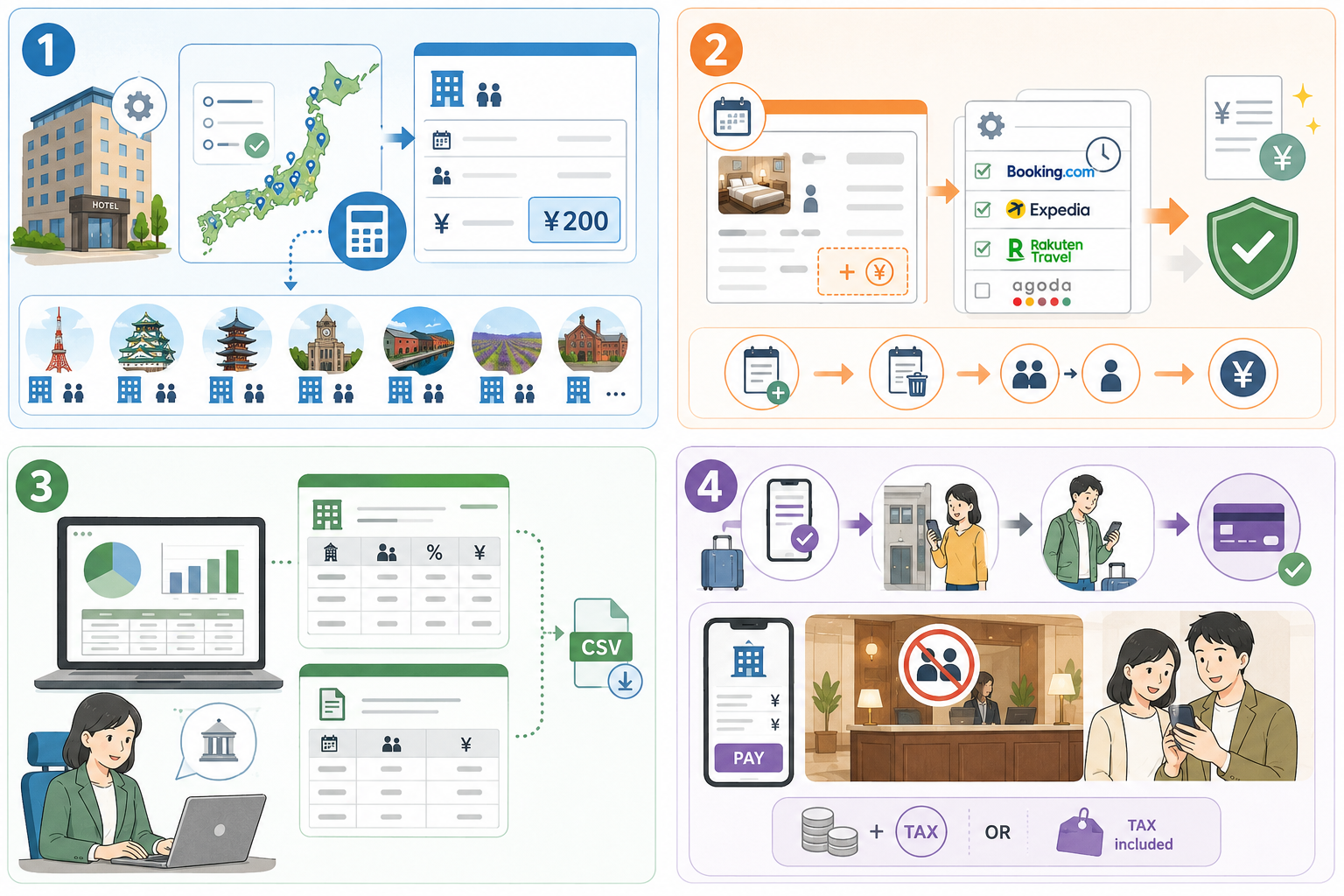
AirHost covers accommodation tax management with four features.
1. Automatic calculation based on each municipality's rules
Just set the applicable tax region for each property, and in supported regions AirHost automatically determines and calculates the correct tax amount from the room rate and guest count. No more puzzling over tax brackets reservation by reservation.
As of July 2026, automatic calculation covers 12 municipalities: Tokyo, Osaka, Kyoto City, Sapporo, Otaru, Kutchan (Niseko area), Hakodate, Asahikawa, Furano, Abashiri, Obihiro, and Hiroshima Prefecture — with more being added over time. Rate revisions are handled too: Osaka's September 2025 revision and Kyoto's March 2026 revision are both built in, and Kutchan's 3% percentage-based tax is supported alongside the tiered systems.
For regions without automatic calculation, flat-rate and percentage-based tax settings can be configured manually.
2. Automatic addition to reservations
With the automatic tax add-on enabled, the accommodation tax line item is added to new reservations automatically, with configurable timing (from booking creation up to 7 days before check-in). You can exclude specific OTA channels — useful when a channel already collects the tax on your behalf.
If a reservation is cancelled, the auto-added tax is removed automatically. If guests change dates or party size, the tax is recalculated. No more fixing line items every time a booking changes.
3. Tax reports for filing
In the supported regions listed above, the Accommodation Tax Report aggregates your reservation data into exactly what municipal filing requires: room-night counts and totals per tax bracket (summary table) plus a per-reservation breakdown of taxable guests and amounts (detail table), both exportable as CSV. No manual spreadsheet work.
Automatic calculation, automatic addition, and the tax report require an eligible plan — contact us for details.
4. Cashless collection — even for unmanned properties
If you collect the tax separately from the room rate, AirHost Check-in's online payment lets guests pay the accommodation tax during pre-check-in or at check-in, fully contactless. For vacation rentals and unmanned hotels with no front desk, this is the practical answer to "how do we even collect it?"
Including the tax in the room rate is also supported, if that's how you prefer to sell.
FAQ
Does AirHost support Japan's accommodation tax?
Yes. AirHost PMS calculates the tax automatically based on municipal rules, adds it to reservations, supports online collection from guests, and generates filing reports.
Which municipalities are supported?
As of July 2026, automatic calculation covers 12 municipalities: Tokyo, Osaka, Kyoto City, Sapporo, Otaru, Kutchan, Hakodate, Asahikawa, Furano, Abashiri, Obihiro, and Hiroshima Prefecture, with more added over time. Manual flat-rate and percentage settings are available everywhere else.
Can I collect the tax at an unmanned property?
Yes. Guests can pay the accommodation tax online through AirHost Check-in before or at arrival — no front desk required.
What about OTA reservations?
Tax handling varies by OTA. AirHost lets you exclude specific channels from automatic tax addition, so you only charge the tax on reservations where it hasn't already been collected.
Is the tax charged to foreign guests too?
Yes — Japan's accommodation tax applies equally to domestic and international guests.
Summary: accommodation tax readiness is a 2026 requirement
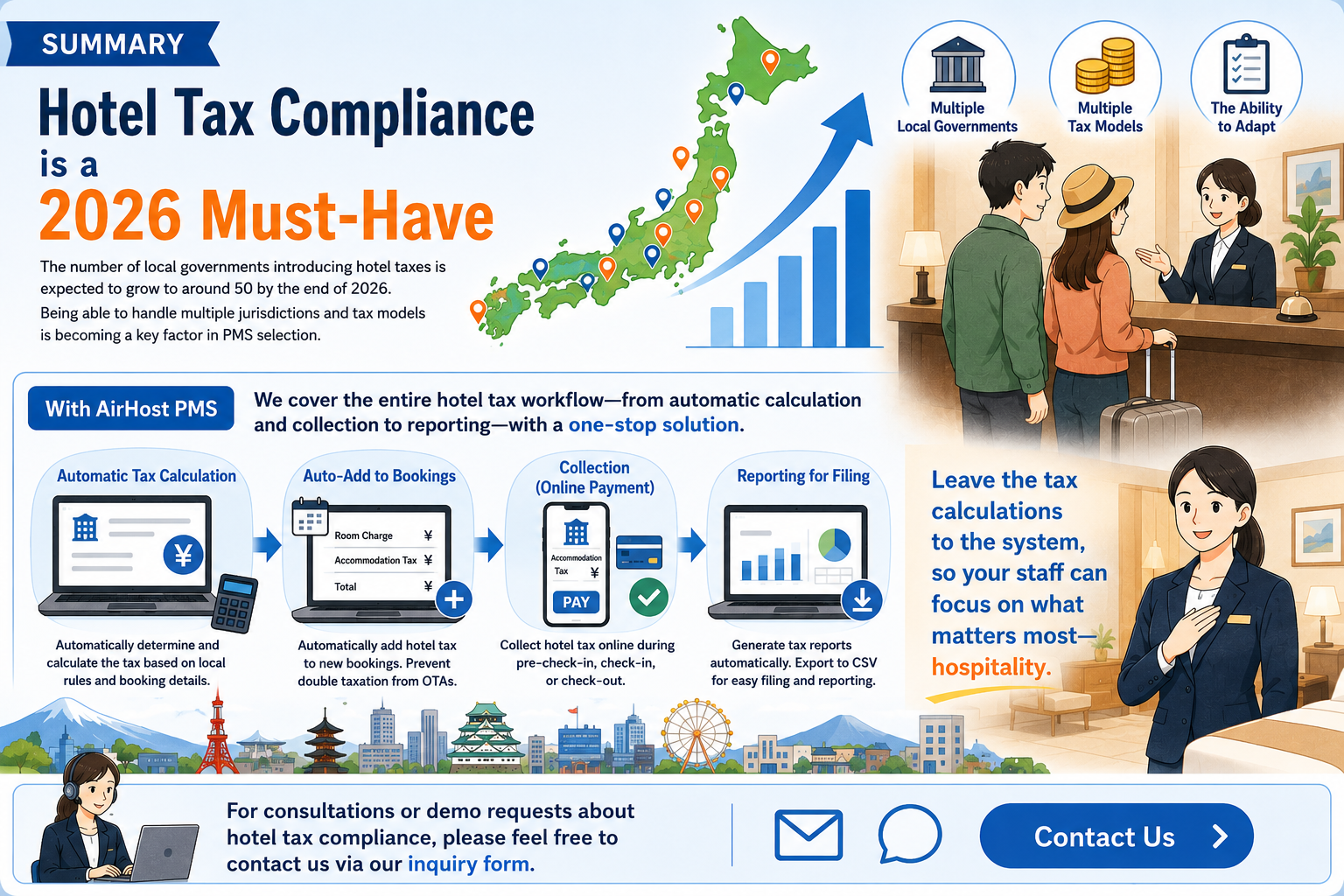
With roughly 50 municipalities expected to levy the accommodation tax by the end of 2026, the ability to handle multiple municipalities and tax structures has become a key criterion when choosing a PMS for the Japanese market.
AirHost covers the full workflow — calculation, collection, and reporting — in one platform. Let the system handle the tax math, so your team can focus on your guests.
Wondering whether it fits your setup? Get in touch — we'll walk you through pricing, supported languages, and what setup actually looks like for your properties. Most operators are up and running in days, not weeks. No hard sell, just a straight conversation.
Related articles
Tax information in this article is current as of July 2026. Always confirm the latest rules on each municipality's official website.
Let AirHost help your business grow.
Our experts are here to support your requests anytime.